AMC 8 · 2003 · #24
Grade 8 rate-ratio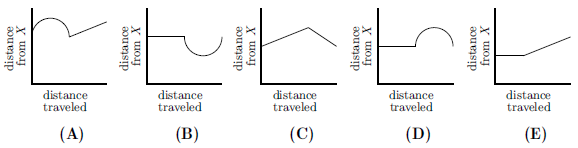
Pick an answer.
AMC 8 2003 problem © Mathematical Association of America (MAA AMC). Reproduced for educational use.
The problem is about positions, paths, and a graph — exactly what Tool #1 (Draw a Diagram) is for. Putting X at the origin turns the question into something we can measure. Tool #7 (Identify Subproblems) tells us to handle leg A → B and leg B → C separately, because they obey completely different rules (circle vs. straight line). Tool #9 (Solve an Easier Related Problem) lets us sidestep messy algebra on the second leg: instead of computing the distance at every moment, we only check the start, the middle, and the end of BC, which is enough to pin down the shape of the graph.
Put X at the origin. Then B = (r, 0) and C = (0, r), so distance from X is just distance from the origin.
Grade 6 coordinate-plane geometry: choosing axes so the key point sits at the origin makes every distance easy to read.
6.G.A.3Draw A DiagramLeg 1 (A → B): every point of a circle centered at X is the same distance from X, so the distance stays r the whole way.
Grade 7 circle facts: the radius is the defining constant of a circle, so a path along the circle cannot change distance from the center.
7.G.B.4Identify SubproblemsSo on the graph, leg 1 is a flat horizontal segment at height r — any choice whose first piece isn't flat is out.
Grade 8 graph reading: "constant value" on a real situation translates to "horizontal" on a graph of that value vs. time.
8.F.B.5Draw A DiagramLeg 2 (B → C): sample just three points — start B, midpoint M = (, ), end C. That's the easier sub-problem.
Grade 6 coordinate work: the midpoint of a segment is the average of its endpoints' coordinates.
6.G.A.3Solve An Easier Related ProblemBy the Pythagorean theorem the endpoints are r from X, but the midpoint is closer: XM ≈ 0.71 r.
Grade 8 Pythagorean distance formula: distance from the origin to (a,b) is √(a² + b²).
8.G.B.8Solve An Easier Related ProblemSo leg 2 makes a smooth symmetric dip from r down to about 0.71 r and back — a curve, not a straight-line V.
Grade 8: a V-shape on a graph means a linear change with a sudden corner. Distance from a point to a moving line-point is nonlinear, so the graph curves.
8.F.B.5Identify SubproblemsStitch them: a flat segment at height r, then the smooth dip back to r. The only choice with that exact shape is (B).
Grade 8 graph matching: combine the qualitative features of each leg (flat, then curved-dip) and find the one option whose silhouette matches.
8.F.B.5Draw A DiagramWhenever a ship rides a circle around a point, its distance to that point cannot change. Whenever it cuts across in a straight line, the distance changes smoothly — never in a sharp V. Spotting those two shapes turns this AMC 8 problem into a Grade 8 graph-reading exercise.