AMC 8 · 2024 · #19
Grade 4 rate-ratio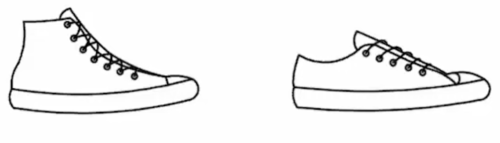
Pick an answer.
AMC 8 2024 problem © Mathematical Association of America (MAA AMC). Reproduced for educational use.
Two classifications (color and style) overlap, so the first move is Tool #1 — draw a 2 by 2 table that shows the four cells (red high-top, red low-top, white high-top, white low-top) all at once. The goal "make the red high-top cell as small as possible" is hard to attack directly, but flipping the perspective with Tool #16 turns it into the much easier goal "make the red low-top cell as large as possible." Finally Tool #6 (Guess and Check) lets us try x = 0, 1, 2, 3, 4 in turn and pick the smallest x that keeps every cell ≥ 0. We do not need Tool #13 (algebra) — table + complement + check is enough.
Take a fraction of the whole: × 15 = 9 red and 15 - 9 = 6 white; × 15 = 10 high-top and 15 - 10 = 5 low-top.
Taking or of a whole number to find "how many" is exactly Grade 4 multiplication of a fraction by a whole number.
4.NF.B.4Draw A DiagramDraw a 2×2 table with x = red high-top; row/column sums force red low-top = 9 - x, white high-top = 10 - x, white low-top = x - 4.
Sorting items by two categories (color and style) into the cells of a table is the Grade 1 "organize, represent, and interpret data with up to three categories" idea.
1.MD.C.4Draw A DiagramFlip the goal: minimize x by maximizing red low-top = 9 - x. It can't exceed the 5 low-tops, so 9 - x ≤ 5, forcing x ≥ 4.
Swapping a hard "minimize" question for an easier "maximize the leftover" question, then doing 9 - 5 = 4, is just subtraction within 100 — a Grade 2 skill.
2.NBT.B.5Count The ComplementGuess and check x = 0,1,2,3: each forces red low-top above 5 — impossible. Only x = 4 gives red low-top 5, white high-top 6, all cells fit.
Plugging in candidate values and checking whether subtractions stay non-negative is Grade 2 subtraction-within-100 work.
2.NBT.B.5Guess And CheckDivide the minimum count 4 by 15 to get , already in lowest terms — choice (C); the other choices need x = 0 or 3, both impossible.
Writing "4 out of 15 equal pairs" as the fraction is the Grade 3 idea of a fraction as a part of a whole split into equal parts.
3.NF.A.1Draw A DiagramThis AMC 8 problem only needs Grade 4 "fraction of a whole number" and a simple table you already know!
More like this
Same archetype — closest grade level first.


