AMC 10 · 2024 · #22
Grade 8 geometry-2d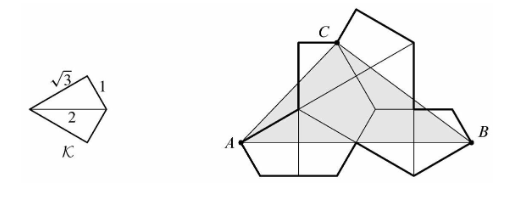
Pick an answer.
AMC 10 2024 problem © Mathematical Association of America (MAA AMC). Reproduced for educational use.
The whole problem lives inside one picture, so Tool #1 (Draw a Diagram) drives everything: re-mark the figure with the kite's actual side lengths (1, 1, √(3), √(3)) and angles, and the tiling tells you exactly how AB and the altitude to AB are built from kite edges. Tool #7 (Identify Subproblems) then splits "area of △ ABC" into two independent measurements — base AB and height h from C — each of which is a short Pythagorean-theorem calculation on one small piece of the tiling. With base and height in hand, the final area is one Grade 6 formula.
Each kite half is a right triangle with legs 1 and √(3); by the Pythagorean theorem the shared hypotenuse is 2, fixing all sides and angles.
Grade 8 Pythagorean theorem on the simplest possible right triangle — the legs are already given.
8.G.B.7Draw A DiagramSplit area = ½·AB·h into two measurements: by symmetry the altitude hits AB's midpoint, so just find the base AB and the height h.
Grade 6 area-of-triangle formula tells us exactly which two numbers to chase — no more, no less.
6.G.A.1Identify SubproblemsEach of AB's four equal segments is the long leg of a small similar triangle: √(3)·() = ; four of them give AB = 6.
Grade 8 similar figures: same angles means sides scale by one common factor — here , the ratio of the new hypotenuse to the original.
8.G.A.4Draw A DiagramThe altitude stacks the small triangle's vertical leg under a vertical kite side √(3), so h = (namely √(3) + ).
Grade 7 rational arithmetic — same as adding 1 + = , only with the common factor √(3) along for the ride.
7.NS.A.1Draw A DiagramWith the base AB and height h in hand, apply ½·base·height to close out the area.
Grade 6 closing move: with base and height in hand, multiply and halve.
6.G.A.1Identify SubproblemsWhen a figure is tiled by repeated pieces, label one piece carefully and use similar-triangle scaling to read the base and height of the big triangle straight off the picture — then · base · height closes it out.
More like this
Same archetype — closest grade level first.

