AMC 8 · 2003 · #23
Grade 4 pattern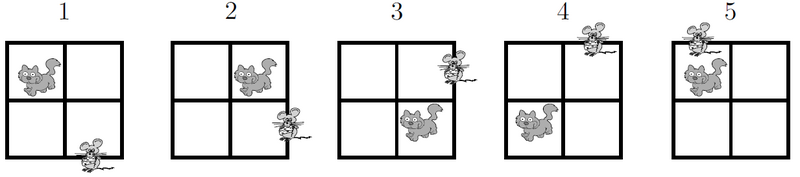
Pick an answer.
AMC 8 2003 problem © Mathematical Association of America (MAA AMC). Reproduced for educational use.
The cat and mouse each repeat their orbit on a fixed schedule — Tool #5 (Look for a Pattern) is exactly the "find the 247th term of a repeating cycle" move. The cycles have different lengths (4 for the cat, 8 for the mouse), so we handle each animal as its own easier problem (Tool #9): find the position after the first cycle's worth of moves, then jump to move 247 using the remainder modulo the cycle length. Finally, Tool #3 (Eliminate Possibilities) checks the five diagrams against the cat square and mouse edge we computed and picks the unique match.
The cat loops clockwise through the four squares, so its cycle length is 4.
Grade 4 "generate a repeating pattern." Four squares in a loop means four states before the pattern repeats.
4.OA.C.5Look For A Pattern247 divided by 4 leaves remainder 3, matching the cat's spot after move 3.
Grade 4 division-with-remainder: after 61 complete clockwise loops, the cat takes 3 more steps.
4.OA.A.3Solve An Easier Related ProblemTracing the loop, move 3 lands the cat in the bottom-right square.
The pattern repeats every 4 moves, and the 3rd position in the loop is the bottom-right square.
4.OA.C.5Look For A PatternThe mouse loops counterclockwise through the eight outer edges, so its cycle length is 8.
Eight edges around the outside of the block means eight states in one loop.
4.OA.C.5Look For A Pattern247 divided by 8 leaves remainder 7, matching the mouse's edge after move 7.
After 30 complete counterclockwise laps, the mouse advances 7 more edges from its starting edge.
4.OA.A.3Solve An Easier Related ProblemFollowing the loop, edge 7 puts the mouse on the bottom edge of the bottom-left square.
The mouse's loop is 8 steps long; the 7th entry sits on the bottom edge of the bottom-left square — one step before completing the lap.
4.OA.C.5Look For A PatternOnly one diagram shows the cat bottom-right and the mouse on that bottom-left edge — choice (A).
Two independent matches narrow five diagrams to one — Tool #3 (Eliminate) finishes the problem.
4.OA.A.3Eliminate PossibilitiesBig move numbers in a repeating loop reduce to a small remainder. Once you know the cat repeats every 4 moves and the mouse repeats every 8, 247 collapses to the 3rd cat position (bottom-right) and the 7th mouse position (bottom edge of bottom-left) — diagram (A).