AMC 8 · 2022 · #25
Grade 7 probabilitycounting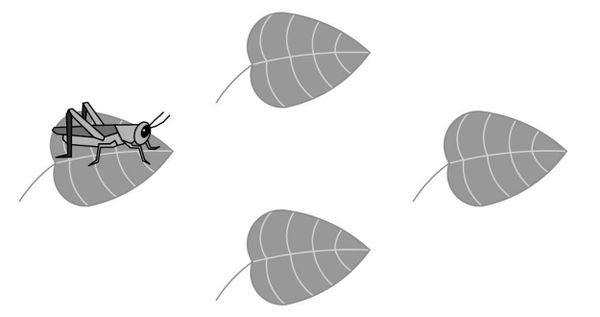
Pick an answer.
AMC 8 2022 problem © Mathematical Association of America (MAA AMC). Reproduced for educational use.
Going from 4 jumps to the answer in one shot is hard, but going from n jumps to n+1 jumps is easy — that is exactly Tool #9 (Solve an Easier Related Problem) applied to the time variable. Use Tool #1 (Draw a Diagram) to picture the 4 leaves with edges between every pair (K₄); the picture makes the symmetry obvious — leaves B, C, D are interchangeable, so they always share the same probability q_n of holding the cricket after n jumps. That symmetry collapses 4 unknowns down to just two (p_n for leaf A and q_n for any other leaf), and Tool #5 (Look for a Pattern) then turns the problem into a tiny one-step recursion that we run for n=1,2,3,4.
Draw leaves A, B, C, D and join every pair — the graph K₄; each leaf has 3 equally likely jumps, and B, C, D play symmetric roles.
Drawing K₄ shows that all non-A leaves play the same role, so we only need two numbers to track the cricket: "on A" or "on one of the others."
7.SP.C.7Draw A DiagramTrack two numbers after n jumps: p_n = chance on A, q_n = chance on one specific other leaf; symmetry forces p_n + 3 q_n = 1.
Collapsing the four leaves into the two cases "on A" / "on a typical other" is the Tool #9 move: the easier related problem has only 2 states instead of 4.
7.SP.C.7Solve An Easier Related ProblemOne-step rules: reach A only from an other leaf that picks A, so p_n+1 = q_n; reach a given other by two paths, q_n+1 = .
Each rule just adds up "chance of being there" × "chance of jumping here" — Grade 5 fraction-times-fraction reasoning.
5.NF.B.4Look For A PatternRun it from p₀ = 1, q₀ = 0: p₁ = 0, p₂ = , p₃ = , then p₄ = , checking p_n + 3 q_n = 1 each step.
Adding fractions like + = is exactly the Grade 5 "unlike denominators" skill repeated four times.
5.NF.A.1Look For A PatternAfter 4 jumps the cricket is back on start leaf A with probability , which is choice (E).
Compound-event probability over 4 jumps lands cleanly on a fraction in the answer list — Grade 7 probability of multi-step events.
7.SP.C.8Solve An Easier Related ProblemThis AMC 8 problem only needs Grade 7 compound-event probability — "chance of step 1 times chance of step 2 times..." — that you already know!