AMC 8 · 2024 · #6
Grade 2 arithmetic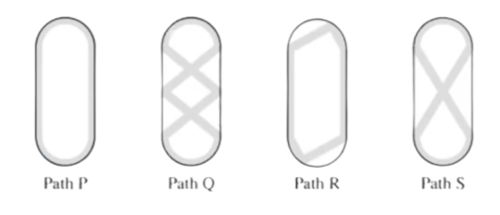
Pick an answer.
AMC 8 2024 problem © Mathematical Association of America (MAA AMC). Reproduced for educational use.
The whole problem IS a picture, so Tool #1 (Diagram) is unavoidable — we work directly on the figure, looking for which segments of one path match segments of another. Comparing four paths at once is hard, so we use Tool #7 (Subproblems) to break the task into three easy pairwise comparisons: (R vs P), (S vs Q), and (P vs S). Each pairwise comparison is a one-line observation about straight-vs-curved or straight-vs-zigzag. Finally, we use Tool #3 (Eliminate Possibilities) on the five answer choices: each inequality we prove rules out the choices that violate it, and only one option survives. No algebra, no measurements, no formulas — just looking at the picture carefully.
Paths R and P share the two long sides; only the ends differ — P uses arcs, R uses straight chords. A chord beats an arc, so R < P.
Even Kindergartners can put two lines next to each other and see which one is longer.
K.MD.A.2Draw A DiagramPath S is a straight corner-to-corner diagonal; Q detours sideways before finishing. A straight line beats a zig-zag, so S < Q.
Pulling a zig-zag string straight makes it longer — kids see this just by looking.
K.MD.A.2Draw A DiagramOnly P vs S is left. P loops the perimeter once, but S crosses the long rink twice — two diagonals outrun the loop, so P < S.
Recognizing a rectangle's perimeter vs. its diagonals is a Grade 2 shape-attribute skill.
2.G.A.1Draw A DiagramChain the three comparisons: from R < P, P < S, and S < Q, indirect ordering gives R < P < S < Q.
Stacking small comparisons into a single order is exactly what 'order three objects by length' teaches.
1.MD.A.1Identify SubproblemsMatch R < P < S < Q to the choices: every other option misorders a pair, so only (D) R, P, S, Q survives.
Once the order is known, picking the matching choice is straight Grade 1 length-ordering.
1.MD.A.1Eliminate PossibilitiesThis AMC 8 problem only needs Grade 2 shape recognition and length comparison you already know!
More like this
Same archetype — closest grade level first.


